Blockchain:
- The algorithm behind distributed ledger technology
- By Satoshi Nakamoto
- Used In
- Crypto-Currency
- Business Network Applications
- Banking & Finacial
- Real Estate
- Election
History:
- Inspired by timestamp-based ordering algorithms to prevent tampering of documents.
- First introduced in a research paper in 2008.
- The major purpose was to :
- To solve the double-spending problem
- And eliminate the need of central trusted third party
- The major purpose was to :
Double Spending Problem:
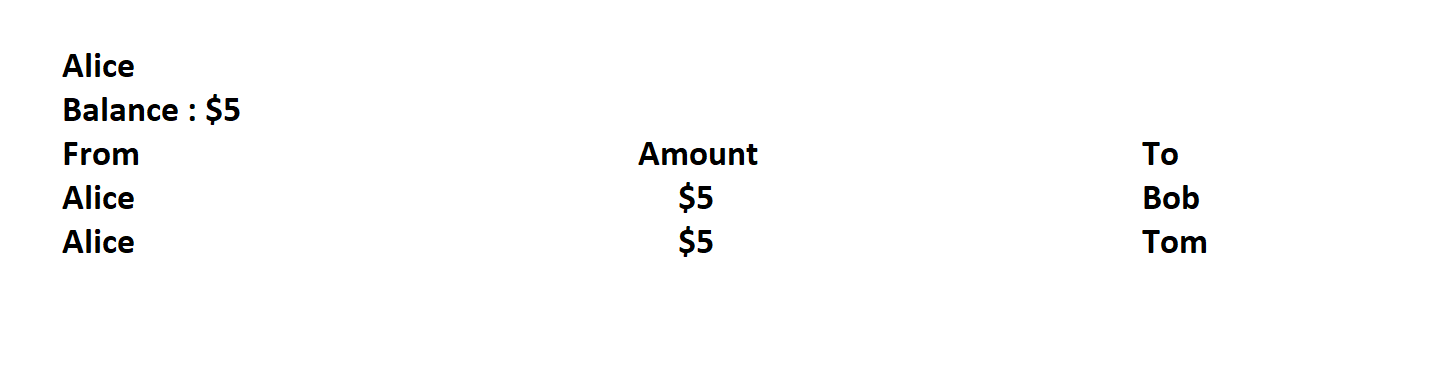
- Before the first transaction gets confirmed, the amount is double spent on the recipient.
- Here we are considering this transaction is happening in a distributed system in which multiple servers or nodes having a copy of Alice balance.
- Before all the nodes get the updated balance of Alice or confirmed from all the nodes someone just made a fault entry that Alice sent $5 to Tom, so this creates the problem in a distributed transaction.
The Need Of Third Party For Trust:

P2P(Process to Process) cryptographic payment system solves these both problems.
- Blockchain is larger number of distributed blocks of data.
- Holds the ledger of transactions from the beginning of time(of the system)
- When the first block is added to the blockchain at time T0(T zero), it is called the Genesis block.
- Each block in the chain has reference to the previous block.

- The blocks are distributed over a P2P network.
- P2P network in which every node is connected to each other node either directly or indirectly.
- Each node/peer contain entire copy of the blockchain.
- Whenever a new transaction is added:
- Added in a block on the node.
- Block is broadcasted to all the nodes.

- Once all the nodes verified the transaction that is added to the node.
- P2P network is to establish a trusted framework.
- If 51% of the nodes remain honest nodes which means the nodes which are having the correct info of transactions are higher in the system.
- It will be difficult for the fraudulent nodes to catchup.

The Block Structure:
- The block contains the ledger/transaction data
- The block data is hashed by cryptographic hash functions.
- Cryptographic Hash Functions
- One way hash functions
- It is difficult to find another hash value for the same string.

- Block Structure
- Block No.
- Data:
- Transaction/Ledger
- Nonce
- Block Hash
- Prev Block Hash
- Data:
- Block No.
Hashing of Block:

Forming A Chain:
- The first is the Genesis block(the previous pointer is 0).
- The valid block is added to the chain.
- Each block contains a pointer to the previous hash.
- The chain of blocks contains the ledger of all the systems.
Anyone trying to change the data in any of the blocks in the blockchain will:
- Change the hash of the current block
- The prev pointer of the next block will be changed.
- And hence all subsequent blocks will be changed.
- Hence this breaks the chain.
- However, the attacker will be required to hash all the blocks again to change the complete chain.
- Proof of work will make this further difficult.
Proof of Work:
- Produce a challenge to the user/computer.
- Basically, we create a challenge for the user/computer to generate data according to the nonce value we provide in the block.
- If the user/computer is capable to generate the proof of work, user/computer is validated and added to the blockchain.
- And eliminate entities which are slow or not capable enough to generate the proof of work.
- Find or generate a value which is :
- Difficult to generate
- And yet easily verifiable
- For example:
- Proof of work: Block hash should have n leading zeros. For example n=4, hash should have value 4 leading zeros.
- 0000Ab23………………………………………………………0Ab23.
- Leading 4 zeros initially in this hash.
How to get such proof of work:
- Generate Nonce, maybe by BruteForce such that:
- Combination of Nonce and Block data generates the leading zeros.
- As per the difficulty of the challenge (value of n).
- More the value of n more the difficulty.
- We can have our own custom algorithm to make this more difficult.
Significance of Proof of Work:
- Signifies that the computation required is exponential to the no. of leading zeros required.
- Once the CPU effort has been expended to make satisfy proof of work the block can’t be changed.
- Until redoing the proof of work(if the data of the block has been changed).
- Redoing will require the entire chain to be redone.
A Validity of Proof of Work:
- Even if the attacker tries to catch up and produce the proof-of-work faster, the added block will be assessed again when a new block is added.
- Chain with longest proof-of-work will be accepted.
- A parallel chain is formed.
- Other blocks will be rejected ( called the dangling block/branch).
- Consensus will verify the block.
- As no. of blocks increases, the probability of a slower attacker catching up diminishes.
Transactions:
- Transactions are generally stored in Merkel tree.
- Transactions are hashed & paired again.
- Each transaction record is hashed.
- The process repeats until there is only one root hash.

How The User Authentication Happens In Blockchain?
- Each transaction record is signed by the private key of the sender.
- The signature is appended with the transaction.
- At any point of time, it can be validated that transaction if initiated by a particular sender.
- The public key of the sender can be used to generate the signature which can be validated.
- A lot of other cryptographic arrangements can be used for further securing the transaction records.
 SFDCWallah
Leave a comment